Physical Address
304 North Cardinal St.
Dorchester Center, MA 02124
Physical Address
304 North Cardinal St.
Dorchester Center, MA 02124

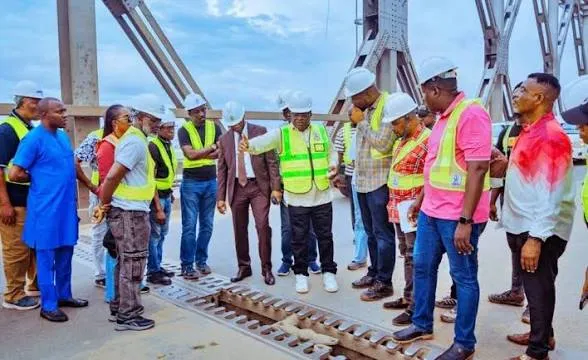
The Federal Government has extended the closure of the First Niger Bridge to traffic as the Minister of Works, Senator David Umahi, insisted that the bridge would not be reopened until critical rehabilitation and safety works were completed.
Umahi made this known on Wednesday at the Onitsha Bridge Head after inspecting ongoing rehabilitation work on the bridge, which connects Anambra and Delta states.
The bridge was earlier closed to traffic for emergency repairs following the discovery of vandalised structural components, including bolts, nuts and sections of the expansion-joint steelwork.
The closure, which was initially expected to end on September 21, has now been extended by another week due to persistent rainfall that has affected the pace of work.
Umahi commended the contractor, SKECC, for the progress recorded since the rehabilitation began, noting that the damaged and vandalised bolts had been replaced and properly secured.
He also disclosed that the specialised expansion joint that had been stolen had been manufactured and transported into the country for installation.
The minister said the level of work completed within about 10 days was encouraging but stressed that safety considerations would determine when the bridge would be reopened.
“We are not going to be stampeded to open the bridge until the major structural work has been achieved,” Umahi said.
Additional Rehabilitation Works Ordered
The minister directed the contractor to include additional rehabilitation works in the ongoing project to further improve the condition and appearance of the bridge.
Among the additional tasks is the repainting of the bridge’s structural components, including the caps and internal carriageway areas.
Umahi also ordered the removal of illegal advertisements mounted on the bridge, saying the structure should be properly maintained and kept free from unauthorised installations.
He directed the installation of additional solar-powered streetlights to improve visibility and security, while also ordering the completion of CCTV cameras on the bridge.
According to the minister, the surveillance system should be connected to the CCTV network on the Second Niger Bridge to improve monitoring and security around the two major crossings.
Umahi further directed that an empirical assessment be carried out on the bridge’s structural elements both above and below the water level.
He said the assessment was necessary to establish the current condition of the bridge and identify any additional areas requiring attention.
The minister directed that the assessment report be submitted to him before the completion of the current phase of rehabilitation.
Approach Roads to Receive Attention
Umahi also raised concerns about the proposed use of asphalt on the approaches to the bridge.
He directed that the proposed treatment of the approach roads be reviewed, suggesting that concrete should be used in sections that would later be reconstructed.
According to him, the approach would prevent the government from spending money on asphalt only to remove it when major reconstruction work begins.
He explained that one carriageway could subsequently be opened to traffic after the concrete had attained the required strength, while rehabilitation continued on the other carriageway.
Delta Government Commends Rehabilitation
Speaking on behalf of the governors of Delta and Anambra states, the Delta State Commissioner for Works (Rural Roads) and Public Information, Charles Aniagwu, commended the Federal Government for the pace and quality of the rehabilitation work.
Aniagwu recalled that Umahi had inspected the bridge on August 28 and directed the replacement of the vandalised bolts, nuts and expansion-joint components.
He said the directives had been implemented, while portions of the deteriorated asphalt surface had also been removed and replaced.
“We are pleased with the speed of work. We want to also appreciate our people who demonstrated a whole lot of patience to understand that you are after their safety,” Aniagwu said.
He said the rehabilitation had already resulted in a significant improvement in the condition of the bridge and expressed confidence that the completed work would provide a lasting solution to the identified structural problems.
The continued closure means motorists using the route will have to endure the associated traffic challenges for at least another week, as the Federal Government prioritises the completion of critical repairs before reopening the strategic bridge.
The First Niger Bridge remains an important transportation link between communities in the South-East and South-South regions, making the quality and safety of the rehabilitation work a key consideration for its eventual reopening.
Join us on our WhatsApp Platform @KOIKIMEDIA NEWS YOUR PAGE
Koikimedia Bringing the World 🌎 Closer to Your Doorstep

[mc4wp_form id=2402]