Physical Address
304 North Cardinal St.
Dorchester Center, MA 02124
Physical Address
304 North Cardinal St.
Dorchester Center, MA 02124

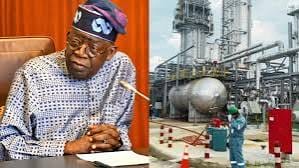
President Bola Tinubu has expressed confidence that Nigeria’s state-owned Port Harcourt and Warri refineries will resume operations, rejecting former President Olusegun Obasanjo’s long-standing doubts about the viability of government-owned refineries.
Tinubu made his position known when he received the Executive President of the Nigeria Union of Petroleum and Natural Gas Workers, Salimon Oladiti, and other union members at the Presidential Villa in Abuja last week Thursday .
The President said the refineries would return to operation, stressing that his administration was working on a sustainable economic and structural plan for the facilities.
He also said he had accepted responsibility for fixing the assets and liabilities inherited from previous administrations.
“The refineries you mentioned are going to come back to work,” Tinubu said, adding that simply restarting a refinery would not be enough unless it could operate profitably and deliver value to Nigerians.
His position contrasts sharply with Obasanjo’s repeated criticism of government efforts to rehabilitate the refineries.
Obasanjo has argued that the Nigerian National Petroleum Company Limited is unlikely to run the facilities successfully and has advocated greater private-sector participation.
The former President recently recalled that during his administration, he approached Shell to take an equity stake and operate the refineries. According to him, the oil company declined, citing concerns about the small size of the plants, poor maintenance and corruption within the downstream sector.
Obasanjo also recalled that Aliko Dangote had offered $750 million for a 51 per cent stake in two of the refineries during his administration.
He said the transaction was later reversed by the administration of the late President Umaru Musa Yar’Adua after pressure from the NNPC.
He further claimed that about $16 billion had subsequently been spent on attempts to rehabilitate the government-owned refineries, describing the expenditure as excessive compared with the cost of constructing new refining capacity.
Dangote has also previously questioned the government’s turnaround-maintenance approach, arguing that modernising decades-old facilities could create additional technical and operational problems.
Meanwhile, Tinubu’s position appears to align with the current NNPC management, which recently announced plans for a technical partnership with two Chinese companies to rehabilitate and expand the Port Harcourt and Warri refineries.
Energy expert Dan Kunle, however, criticised the continued government spending on the old refineries.
He urged Tinubu to privatise the facilities and redirect public funds towards sectors such as education, agriculture, oil and gas infrastructure and other areas capable of attracting investment.
Kunle argued that previous administrations had repeatedly promised to revive the refineries without achieving sustained, profitable operations.
He maintained that even if the facilities were restarted, they could remain commercially unviable.
He challenged the government to construct a new refinery alongside one of the existing plants and operate both simultaneously, arguing that such a comparison would demonstrate the technical and financial difficulties associated with the older facilities.
Despite the criticism, the Port Harcourt Refinery Host Community Bulk Petroleum Retailers Association has thrown its support behind the President’s efforts.
The association said a fully operational Port Harcourt refinery would create jobs, revive businesses and strengthen energy security in Rivers State.
It estimated that more than 200,000 people depend directly or indirectly on the refinery and related economic activities.
The group also supported the proposed technical partnership between NNPC and Chinese firms, while calling for reliable crude supplies, competent management, proper maintenance and technical expertise.
HOSCOM said it would mobilise support for Tinubu if the Port Harcourt refinery becomes fully operational before the next general election.
The debate over the refineries therefore remains centred on whether the government can transform the ageing facilities into reliable and commercially viable plants.
While Tinubu is determined to see them restored, critics insist that privatisation and new refining capacity may offer a more sustainable solution.
Join us on our WhatsApp Platform @KOIKIMEDIA NEWS YOUR PAGE
Koikimedia Bringing the World 🌎 Closer to Your Doorstep

[mc4wp_form id=2402]