

Koiki has strongly rejected the characterization, insisting it misrepresents the intent and focus of Igboho’s agitation
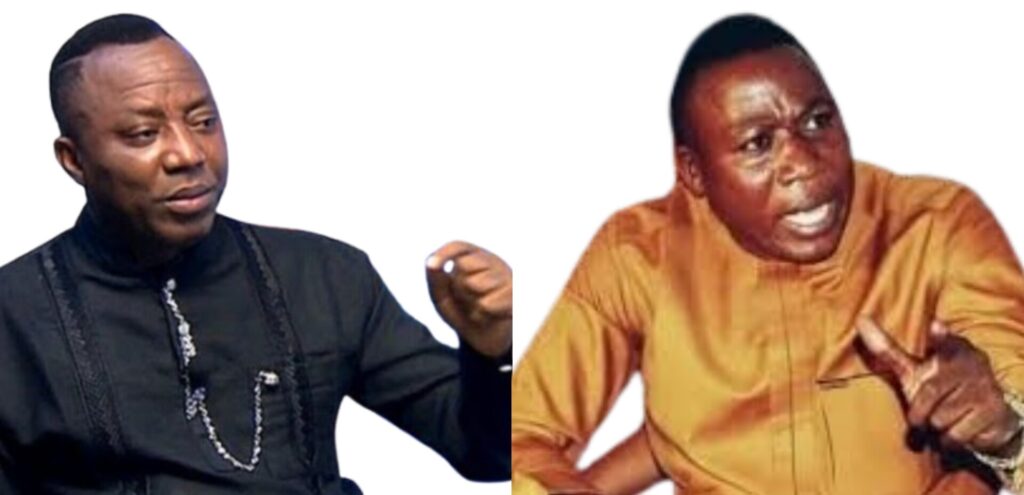
The ongoing social media clash between human rights activist Omoyele Sowore and Yoruba/Odudua nation figure Sunday Adeyemo Igboho has intensified, with Igboho’s spokesperson, Olayomi Koiki, issuing a more detailed response addressing the viral remarks.
Sowore had earlier described Igboho’s activism as “amala politics” in a video circulating on social media, sparking reactions across political and regional lines. However, Koiki has strongly rejected the characterization, insisting it misrepresents the intent and focus of Igboho’s agitation.
In his response, Koiki raised questions about expectations being placed on Igboho regarding national politics, asking whether the Yoruba activist should be compelled to endorse political figures such as Peter Obi or Atiku Abubakar, or even align with Sowore’s political platform. He emphasized that Igboho retains the right to make independent political decisions based on the security interests of Yoruba people.
Koiki reiterated that Igboho’s advocacy is centered on addressing insecurity across Yoruba land, which he described as marked by persistent violence, including killings of farmers, kidnappings along highways, and attacks on traditional rulers and royal institutions.
According to him, these concerns form the basis of Igboho’s movement, rather than any ambition for political office or revolutionary leadership.
Drawing a contrast with Sowore’s ideology, Koiki argued that while Sowore has consistently promoted nationwide revolution as a pathway to leadership, Igboho’s approach is rooted in protecting lives, land, and property within Yoruba territory.
He stressed that the agitation is a response to real and ongoing threats faced by communities in the region.
Referencing recent security incidents in northern Nigeria, including reported explosions in Maiduguri as at yesterday 16 March, 2026, Koiki questioned the broader effectiveness of long-term revolutionary advocacy.
He argued that despite over two decades of activism, there has been little measurable improvement in the living conditions of ordinary Nigerians, particularly in terms of safety and security.
Koiki further challenged Sowore to assess the situation in his home state of Ondo State, citing repeated cases of banditry, kidnapping, and attacks on rural communities. He highlighted the impact on vulnerable groups, including farmers, traditional rulers, women, and children, noting that several communities have reportedly suffered destruction.
According to Koiki, these realities reinforce Igboho’s long-standing call dating back to 2020 for localized security measures and stronger regional protection strategies. He argued that dismissing such efforts as “amala politics” undermines the urgency of the security crisis and the legitimacy of grassroots agitation.
Debunking the viral narrative, Koiki insisted that labeling Igboho’s movement as mere “amala politics” is both inaccurate and dismissive of the genuine concerns driving the agitation.
He urged critics to approach the issue with a clearer understanding of the security realities faced by many communities in the region.
Join us on our WhatsApp Platform @KOIKIMEDIA NEWS YOUR PAGE
koikimedia Bringing the World 🌎 Closer to Your Doorstep