

The country launched a full-scale invasion of Ukraine in February 2022, marking the largest conflict in Europe since World War II.
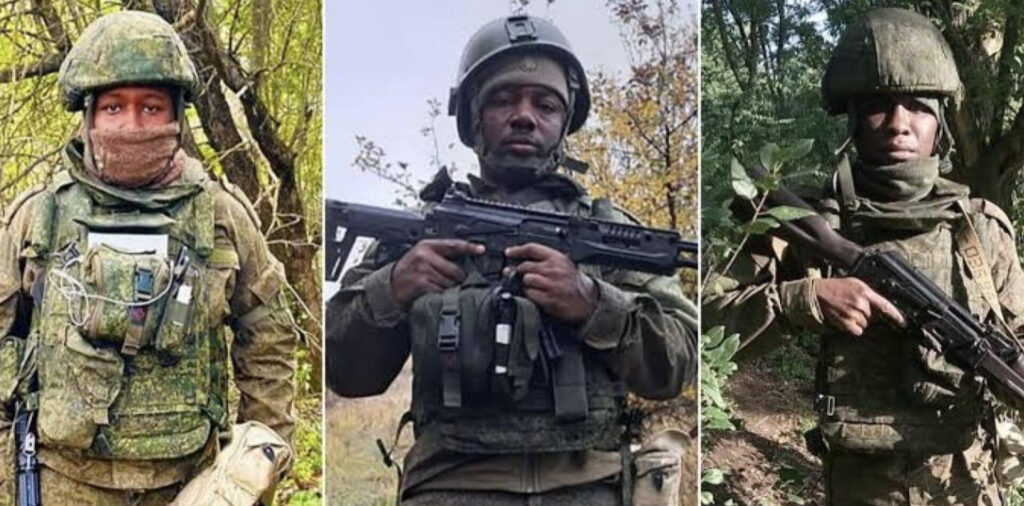
Russia has rejected claims that it hired Nigerians as soldiers to fight in its war against Ukraine.
The country launched a full-scale invasion of Ukraine in February 2022, marking the largest conflict in Europe since World War II.
Last week, a newspaper reported that four Nigerians — Adam Anas, Akinlawon Tunde Quyuum, Abugu Stanley Onyeka, and Balogun Ridwan Adisa — were killed on the frontlines.
The report said they were recruited under the pretext of a “security job” but were conscripted and deployed to the war front after just three weeks of training.
The newspaper cited sources stating that the Nigerians died between December 2025 and January 2026. It claimed the news first emerged in a secret WhatsApp group used by African mercenaries.
According to the report, the Russian Embassy in Abuja issued the men single-entry tourist visas without standard biometric requirements, promising them a monthly salary of 200,000 rubles (about 3.6 million naira) plus allowances.
However, once in Russia, the recruits were allegedly forced into military service with minimal training. They were reportedly made to sign contracts in Russian without translation or legal counsel, and their passports were allegedly confiscated, preventing them from leaving.
Reacting in Abuja on Tuesday, Russian Ambassador Andrey Podyolyshev dismissed the claims, insisting no official programme exists to recruit Nigerians for the war.
“There is no government-supported programme to recruit Nigerians to fight in Ukraine. If illegal organisations or individuals are trying to recruit Nigerians unlawfully, this is not connected with the Russian state,” Podyolyshev said.
He added that any information could be forwarded to Russian law enforcement for investigation. Responding to Western media reports, he accused them of trying to “demonise Russia” and suggested journalists visit Russia to understand the situation firsthand.
Acknowledging that some Nigerians may be in the conflict zone, Podyolyshev emphasised there is no official Russian policy behind their presence.
The ambassador also called for stronger economic ties between Russia and Nigeria, noting that the last session of the Russia–Nigeria Intergovernmental Commission on Economic Cooperation took place a decade ago. He highlighted Nigeria’s leadership role in ECOWAS and the African Union, recalling its peacekeeping contributions in Liberia, Sierra Leone, and The Gambia.
On energy cooperation, Podyolyshev said both countries are working on long-term projects, including nuclear energy collaboration.
Join us on our WhatsApp Platform @KOIKIMEDIA NEWS YOUR PAGE
koikimedia Bringing the World 🌎 Closer to Your Doorstep