Physical Address
304 North Cardinal St.
Dorchester Center, MA 02124
Physical Address
304 North Cardinal St.
Dorchester Center, MA 02124

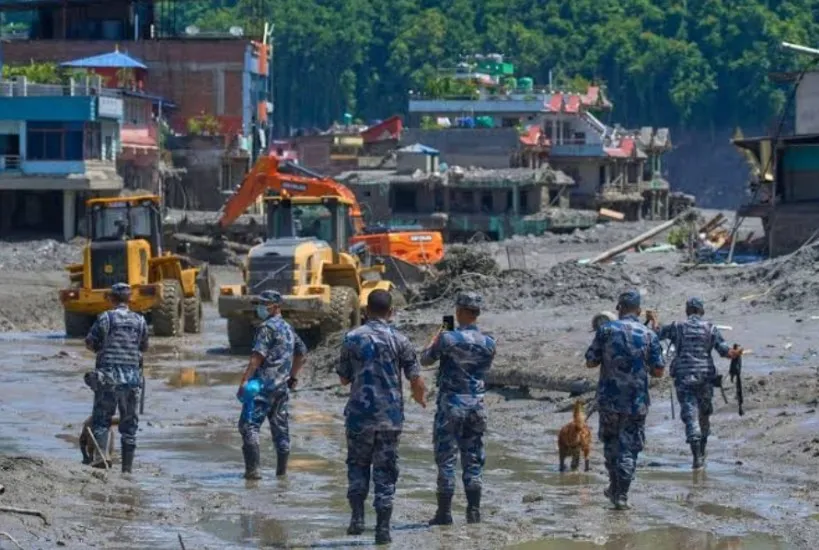
The death toll from devastating flash floods and landslides across Nepal and Tibet has risen to more than 470, as rescue teams continue searching for survivors and missing people on both sides of the Nepal-China border.
Nepal’s Prime Minister’s Office said on Friday that 469 people had been confirmed dead, while 977 others remained missing. Chinese authorities reported that at least three people had died in Tibet, with another 558 people still unaccounted for.
Nepalese officials said 644 of those reported missing are foreigners, while approximately 1,550 people have so far been rescued.
The disaster began on Wednesday after a glacier collapse triggered a massive surge of ice, water, rocks and mud through valleys in the Himalayas.
The rushing debris swept through communities, buried villages and destroyed roads, bridges and hydropower facilities.
Bishal Nath Upreti, president of the Nepal Centre for Disaster Management, described conditions in the affected areas as extremely difficult.
He said large sections of the road network had been completely destroyed, leaving helicopters as the only practical means of reaching many stranded communities.
According to Upreti, about 800 people have been rescued by helicopter and another 700 by land, while emergency supplies are being transported by air to survivors.
He warned that many people who remain trapped are becoming increasingly desperate after spending more than three days without adequate shelter or food.
The number of missing people could rise further as rescue teams gain access to more isolated areas.
China has deployed around 500 military and paramilitary personnel to assist with the rescue operation, while Premier Li Qiang has travelled to oversee
the response. Nepal, meanwhile, has mobilised around 30,000 security personnel to search remote valleys and assist those affected.
Unstable Barrier Lake Creates New Threat
Rescue efforts are being complicated by fears of additional flooding.
Authorities are particularly concerned about a newly formed barrier lake along the Nepal-China border, which officials from both countries have warned could burst.
Barrier lakes are created when floods or landslides block a river, forming a natural dam that traps water behind accumulated rocks, soil and debris.
Chinese authorities estimate that the newly formed lake already contains around two million cubic metres of water, with an additional three million cubic metres expected to flow into it over the next three days.
The possibility of the natural dam collapsing has forced rescue and military teams working near the Gyirong border port to temporarily halt operations.
Buildings in the area have reportedly been buried beneath about 1.5 metres of mud, while the threat of further landslides continues to put rescuers at risk.
The unstable lake has created an urgent race against time, with rescue teams attempting to locate survivors and recover bodies before worsening conditions make the operation even more dangerous.
Families Wait for News
Nepal’s Foreign Ministry said the country was not currently requesting international assistance for search-and-rescue operations.
Spokesperson Lok Bahadur Chhetri said Nepal’s security agencies were leading the rescue effort and were capable of handling the immediate response.
However, officials have indicated that Nepal remains open to other forms of international assistance, particularly financial support, as the scale of the disaster continues to grow.
At hospitals and other locations in Kathmandu, families have gathered seeking information about relatives who remain missing.
With communication and transportation links severely disrupted in several affected areas, many families are still waiting for confirmation about the fate of their loved ones.
The disaster has left large areas of the Himalayan region cut off, while rescue workers face difficult terrain, destroyed infrastructure, unstable slopes and the growing threat posed by the barrier lake.
Join us on our WhatsApp Platform @KOIKIMEDIA NEWS YOUR PAGE
koikimedia Bringing the World 🌎 Closer to Your Doorstep

[mc4wp_form id=2402]