Physical Address
304 North Cardinal St.
Dorchester Center, MA 02124
Physical Address
304 North Cardinal St.
Dorchester Center, MA 02124

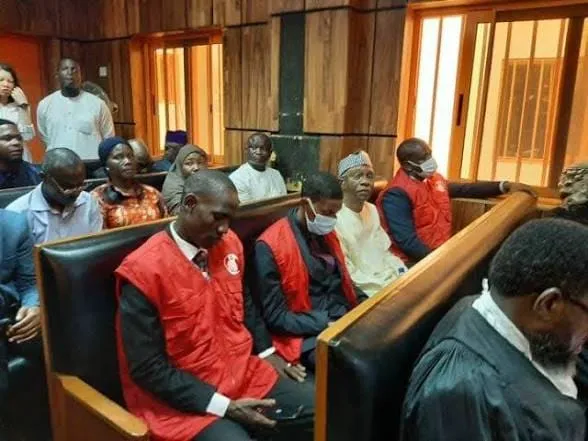
The Economic and Financial Crimes Commission (EFCC) has told an Ikeja Special Offences Court that former Governor of the Central Bank of Nigeria (CBN), Godwin Emefiele, allegedly acquired several high-value properties across the country through associates and other proxies while in office.
An EFCC investigator, Alvan Gurumnaan, made the allegation on Thursday while testifying as the seventh prosecution witness in the ongoing trial of Emefiele and his co-defendant, Henry Omoile.
Gurumnaan, who led the special operations team responsible for investigating the former CBN governor, told Justice Rahman Oshodi that investigators uncovered several properties allegedly linked to Emefiele in Lagos, Delta, Ogun and Abuja.
He further alleged that more than $2m in cash was recovered from the office of a lawyer, Ifeanyi Omeke, who reportedly admitted during investigations that he acted as a front for Emefiele and received money on his behalf.
Emefiele is facing a 19-count charge bordering on alleged gratification, corrupt demands and abuse of office involving transactions valued at $4.5bn and N2.8tn.
His co-defendant, Omoile, is facing a separate three-count charge bordering on the alleged unlawful acceptance of gifts.
Led in evidence by the Director of Public Prosecutions of the Federation, Rotimi Oyedepo (SAN), the EFCC investigator said Emefiele’s statement was recorded during an investigation conducted by the special operations team.
According to the witness, the investigation uncovered an alleged system through which the former CBN governor made it difficult for ordinary Nigerians and business owners to access foreign exchange for legitimate transactions.
He claimed that some businessmen were allegedly compelled to enter into special arrangements before they could obtain foreign exchange for their businesses.
Giving an example, Gurumnaan told the court that a company allegedly paid millions of dollars to Emefiele through members of his staff.
He specifically mentioned Monday Osazuwa, who allegedly admitted during investigations that he received approximately $17m from the company before transferring the money through Omoile to the former CBN governor.
The witness also cited the case of Source Computer, alleging that its managing director was compelled to make payments to Emefiele before the company could receive money due to it under a contract.
Gurumnaan subsequently gave details of several properties allegedly acquired by Emefiele through associates, arguing that their combined value was far beyond what he could legitimately earn as CBN governor.
He told the court that the EFCC had secured several forfeiture judgments relating to assets allegedly connected to the former bank chief, with the recovered properties estimated to be worth hundreds of billions of naira.
According to him, one of the individuals allegedly used to acquire or hold properties on Emefiele’s behalf was a lawyer identified as Ifeanyi Omeke.
The investigator said Omeke’s office was searched during the investigation, leading to the recovery of more than $2m in cash.
He further alleged that the lawyer, who served as secretary to several companies, admitted to acting as a front for the former CBN governor.
Among the properties listed by the witness were a pair of twin duplexes in Lekki Phase 1 and two mansions located on Queen’s Drive, Ikoyi, Lagos.
He also mentioned a factory under construction in Agbor, Delta State, which he described as Emefiele’s hometown, adding that the property had been forfeited to the Federal Government.
Another property allegedly linked to the former CBN governor was a block of eight flats on Adekunle Lawal Street, Ikoyi. Gurumnaan told the court that the building previously belonged to the Nigerian Printing and Minting Company, where Emefiele had served as board chairman.
The investigator further disclosed that the EFCC recovered a warehouse allegedly belonging to Emefiele in Ogun State, near the outskirts of Lagos.
According to him, the facility contained several containers, with their estimated value running into hundreds of billions of naira.
Other properties mentioned during the proceedings included an 11-storey building under construction in Ikoyi, Lagos, reportedly comprising about 94 luxury apartments, and an industrial park being developed in Amuwo Odofin, Lagos.
He also listed an estate comprising approximately 750 housing units in the Lokogoma District of Abuja among the assets allegedly connected to the former CBN governor.
However, the testimony was challenged by lawyers representing both defendants, who argued that the prosecution was introducing allegations and evidence that were not contained in the proof of evidence earlier served on them.
Emefiele’s lead counsel, Ojo Olalekan (SAN), argued that the prosecution could not introduce additional facts through its witness without first filing and serving supplementary proof of evidence on the defence.
He specifically objected to the testimony concerning the properties allegedly recovered by the EFCC and the reported discovery of more than $2m at Omeke’s office.
Relying on Section 251 of the Administration of Criminal Justice Law 2015, the defence counsel maintained that the prosecution was legally required to disclose the relevant information to the defendants before presenting it in court.
He insisted that the objection was not simply about whether the defence would have an opportunity to cross-examine the witness, but whether the prosecution had complied with the required legal procedures.
Omoile’s counsel, Kazeem Gbadamosi, supported the objection, arguing that an investigating officer should restrict his testimony to findings directly connected to the charges before the court.
He maintained that the prosecution had not established a sufficient connection between some of the properties mentioned and the alleged offences for which the defendants were standing trial.
In response, prosecution counsel, Oyedepo, argued that the witness was entitled to present findings made during the investigation, particularly those relating to the alleged acquisition of assets with proceeds of gratification.
He explained that the prosecution’s case was that Emefiele allegedly used money received through corrupt arrangements to acquire properties that were beyond his legitimate sources of income.
The prosecution further maintained that the defendants would not suffer any injustice because their lawyers retained the right to challenge the witness’s claims through cross-examination.
In his ruling, Justice Oshodi dismissed the defence objection, relying on the Supreme Court decision in Ugwuma v. The State (2018).
The judge noted that an investigating police officer could give evidence about matters personally seen, witnessed or discovered during an investigation.
Consequently, he permitted Gurumnaan to continue his testimony, while preserving the defendants’ right to cross-examine him on the allegations.
The proceedings, however, encountered another objection when the witness sought to identify a certified true copy of a Supreme Court judgment relating to some of the properties mentioned in his testimony.
The defence objected, arguing that the document had not been adequately disclosed before the hearing, thereby limiting their opportunity to study it and prepare an appropriate response.
Justice Oshodi deferred consideration of the document and the defence’s objection until the next sitting.
The court subsequently adjourned the case until Friday, November 13, 2026, for continuation of the trial and further consideration of the disputed document.
The allegations remain part of the prosecution’s case, and Emefiele and his co-defendant are entitled to the presumption of innocence until proven guilty by a competent court.
Join us on our WhatsApp Platform @KOIKIMEDIA NEWS YOUR PAGE
koikimedia Bringing the World 🌎 Closer to Your Doorstep

[mc4wp_form id=2402]