Physical Address
304 North Cardinal St.
Dorchester Center, MA 02124
Physical Address
304 North Cardinal St.
Dorchester Center, MA 02124

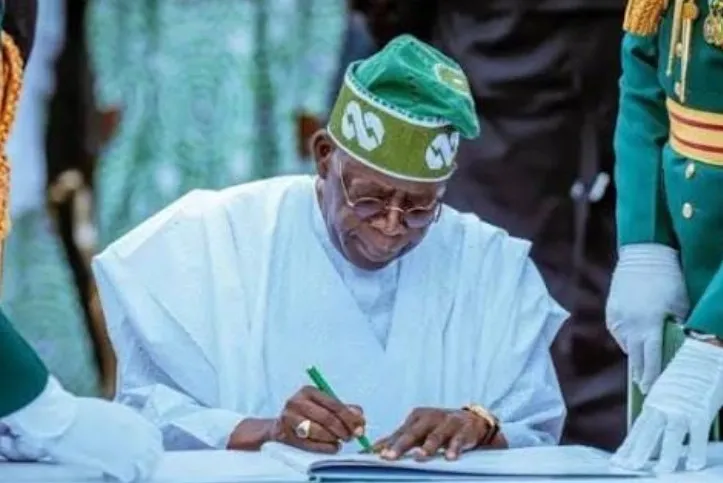
President Bola Tinubu has directed the Federal Ministry of Works to redesign and completely reconstruct the Benin-Agbor-Asaba Road and other major federal highways in Edo State and neighbouring corridors, following growing concerns over deteriorating road conditions across the country.
The directive was issued as the Federal Government intensified efforts to address damaged highways that have caused prolonged traffic congestion, increased transportation costs, damaged vehicles and disrupted businesses and economic activities.
Minister of Works David Umahi inspected the troubled Benin-Agbor-Asaba Road in Edo State on Tuesday, while the Minister of State for Works, Bello Goronyo, visited the Ifaki-Oye-Kabba and Efon-Iwaraja roads in Ekiti State to assess the challenges faced by motorists and residents.
During the inspection in Edo, Umahi apologised to commuters and accepted responsibility for the condition of the road.
He expressed strong dissatisfaction with the company handling the reconstruction and said temporary repairs would not be enough to solve the problem.
The minister directed the ministry to begin plans for the total reconstruction of the highway, stressing that the road needed a permanent solution rather than repeated palliative measures.
The Benin-Agbor-Asaba Road was reportedly in poor condition despite an earlier reduction in the severe traffic gridlock experienced along the route.
The deteriorating highway has continued to affect motorists, traders, businesses and residents who rely on it daily.
Umahi Blames Concessionaire
Umahi criticised the Benin-Asaba Expressway Concessions Company (BAECC), which was awarded the concession in 2025 to reconstruct and expand the road from four to 10 lanes.
He accused the concessionaire of mishandling the project and questioned its technical capacity to execute the work.
Umahi also warned that contractors who remove asphalt from existing federal roads without proper approval would face consequences.
The minister said President Tinubu had directed the ministry to take every necessary step to restore the road and redesign major routes stretching from Kogi through Edo to Warri.
According to Umahi, the redesigned roads would include concrete pavement in some sections to improve durability and reduce the frequency of road failures.
He maintained that the government would work with competent contractors to restore the badly damaged sections, insisting that the condition of the road had become a matter of urgent public interest.
BAECC’s Chief Executive Officer, Samuel Daramola, however, attributed the slow pace of work to heavy rainfall and the high volume of traffic on the highway.
He explained that the company had been forced to keep the road open to motorists while construction was ongoing, making it difficult to complete drainage and other critical works.
The representative of the project consultant, Toyin Akinlapa, said the concessionaire failed to follow instructions to construct drainage infrastructure before proceeding with other aspects of the project.
He added that weaknesses within the company’s technical team also contributed to the challenges.
The Chairman of the House Committee on Works, Akin Alabi, called for a review of concession agreements to ensure that companies awarded major road projects have the technical and financial capacity to deliver them.
Motorists and Businesses Count Their Losses
The poor condition of the Benin-Asaba route has placed a heavy burden on motorists and commuters.
Drivers say journeys that previously took a short period now require several hours because of traffic congestion and damaged portions of the highway.
One regular driver, Nobel Akanuibiam, said a journey from Second Junction in Benin City to Summit Junction in Asaba, which previously took about one and a half hours, can now take as long as five hours.
The additional time on the road has significantly increased fuel consumption and vehicle maintenance costs. He said his fuel expenses had risen from roughly ₦20,000–₦25,000 to about ₦45,000 on some trips.
Drivers have also complained of increased damage to vehicles, including ball joints, shock absorbers and other components that require frequent repairs because of the poor road surface.
The crisis has also affected commercial drivers and traders, who are making fewer trips and spending more money on transportation and vehicle maintenance. Some passengers and motorists have reportedly been forced to spend several hours or even overnight on difficult sections of the road.
Traders operating along the route have equally complained about declining sales, flooding and increased transportation expenses.
Some businesses have reportedly closed temporarily because customers and suppliers are finding it difficult to reach them.
Other Federal Roads Also in Poor Condition
The Benin-Asaba highway is not the only federal road facing serious deterioration. Findings across the country indicate that several major highways are in need of urgent rehabilitation.
In the South-West, roads such as Ibadan-Abeokuta, Lagos-Badagry and Ibadan-Ife-Ilesa have continued to generate concerns.
Several major routes in the South-East and South-South, including Onitsha-Enugu, Enugu-Abakaliki, Onitsha-Owerri, East-West Road, Warri-Sapele and Benin-Sapele, have also experienced varying degrees of deterioration.
In the North, motorists have raised concerns about the condition of routes including Abuja-Kaduna, Abuja-Lokoja, Lokoja-Okene, Kaduna-Kano, Kano-Katsina, Sokoto-Gusau, Maiduguri-Damaturu, Bauchi-Jos and Gombe-Yola.
Federal Government Intervenes in Ekiti
In Ekiti State, Minister of State for Works Bello Goronyo inspected the Ifaki-Oye-Kabba Road, where a badly damaged section had left articulated vehicles stranded for days.
Goronyo expressed concern over the hardship faced by motorists and residents and said emergency intervention had begun to make the road temporarily passable.
He disclosed that the Federal Road Maintenance Agency had deployed equipment and materials to the affected section, while the government was reviewing the funding arrangement for the larger rehabilitation project.
The minister said emergency repairs were expected to restore access within 48 hours, while articulated vehicles would temporarily be restricted from using certain sections until the work was completed.
He also inspected the Efon-Iwaraja Road, where a deep failed section had forced motorists to seek alternative routes.
Goronyo promised immediate remedial action to restore access.
He described the Ifaki-Oye-Kabba route as an important economic corridor linking parts of the South-West with northern Nigeria and stressed that its rehabilitation was essential for the movement of people and goods.
Government Promises Wider Road Rehabilitation
Goronyo said the interventions formed part of President Tinubu’s broader directive to address critical road failures nationwide.
He cited major projects including the approximately 1,068-kilometre Illela-Sokoto-Badagry Highway, the 750-kilometre Lagos-Calabar Coastal Highway and the Abuja-Kaduna-Kano Road.
According to the minister, investment in road infrastructure is essential to economic growth because efficient roads support agriculture, trade, employment, healthcare, security and the movement of goods and people.
He said the administration was determined to complete ongoing projects and address the country’s infrastructure deficit.
Traffic Disruptions in Kano
Meanwhile, reconstruction work along the Zaria Road corridor in Kano State has resulted in significant traffic congestion.
The work is being carried out around the section between the Ado Bayero Flyover, popularly known as Gadar Lado, and Unguwa Uku Motor Park.
The construction has reduced the available carriageway, causing delays for motorists and commuters, particularly during peak periods.
Although the project is expected to improve the road corridor once completed, motorists have called for effective traffic management and temporary measures to reduce the hardship caused by the ongoing construction.
The Federal Government’s latest directives highlight the growing urgency of addressing Nigeria’s deteriorating road infrastructure.
For motorists, traders, transport operators and businesses, the expectation is that the promised reconstruction will move quickly from inspections and emergency repairs to permanent solutions that will make the affected highways safer and more reliable.
Join us on our WhatsApp Platform @KOIKIMEDIA NEWS YOUR PAGE
koikimedia Bringing the World 🌎 Closer to Your Doorstep

[mc4wp_form id=2402]