

An Israeli airstrike targeting a Hamas operative at the popular al-Baqa Cafeteria in Gaza City has left at least 40 people dead, including women, children, students, and artists, raising fresh concerns over the scale of civilian casualties in Israel’s ongoing military campaign
By Titilope Adako
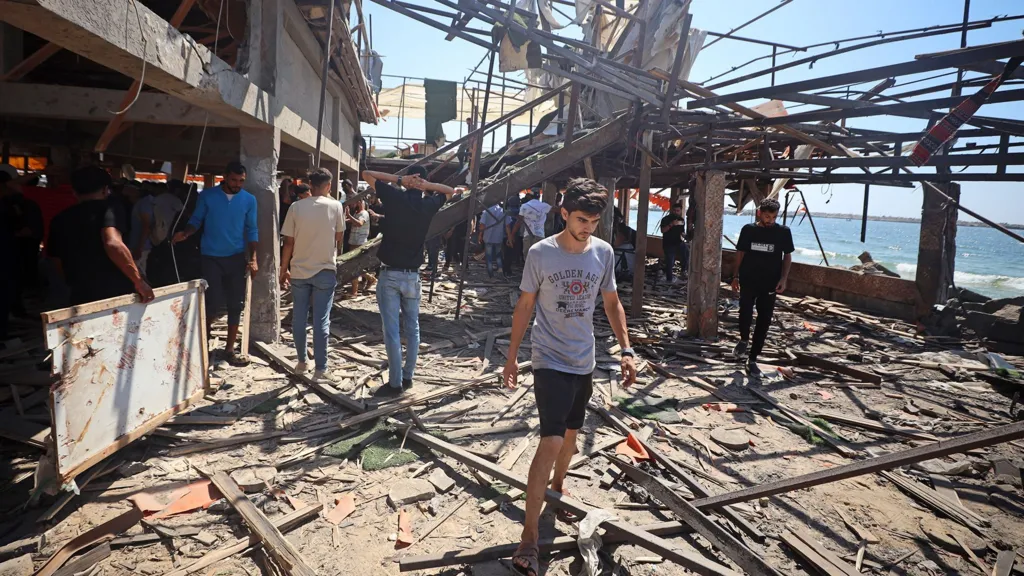
An Israeli airstrike targeting a Hamas operative at the popular al-Baqa Cafeteria in Gaza City has left at least 40 people dead, including women, children, students, and artists, raising fresh concerns over the scale of civilian casualties in Israel’s ongoing military campaign.
The bustling seaside café was filled with civilians on Monday afternoon when the strike occurred.
Moments earlier, patrons were chatting over coffee, browsing their phones, and celebrating a child’s birthday.
According to multiple sources, the target of the strike was a Hamas field commander, 27-year-old Hisham Ayman Mansour, who arrived at the café dressed in civilian clothing.
He was seated in the men’s section by the sea when the explosion ripped through the building.
Eyewitnesses described scenes of horror. “It was total destruction. A real massacre that breaks hearts,” said one survivor.
The BBC confirmed the identities of 29 of the deceased, 26 of whom were verified through family, friends, and eyewitnesses. Among them were a female boxer, artists, a footballer, café staff, and several teenagers.
Gaza’s Shifa Hospital, which received the victims, said the death toll had risen to 40, with 72 others injured—many of them suffering severe burns, amputations, or critical wounds.
The Israel Defense Forces (IDF) acknowledged the strike, stating it was aimed at “terrorists” and that precautions were taken to minimise civilian harm through aerial surveillance. However, the IDF did not confirm the identity of the target or respond to questions about the high civilian toll.
BBC Verify analysts and munitions experts concluded the weapon used was likely a bomb—possibly up to 500lbs in size—dropped by a warplane, not a drone. Satellite images and eyewitness reports supported this assessment.
Though local Hamas sources said Mansour was the target, his cousin described him as a “low-level” fighter no longer actively involved in combat. Two of his relatives, including a child, also died in the blast.
A senior IDF source told the BBC the strike may have hit multiple Hamas operatives, though an official assessment was still ongoing. There were also unconfirmed reports that another senior Hamas commander may have been nearby.
The café had remained a rare safe haven in war-torn Gaza, known for its stable internet and scenic sea view. It had a strict security policy to prevent suspected militants from entering, staff said.
Among the dead were well-known figures in Gaza’s youth and creative community:
Malak Musleh, a young female boxer who trained despite displacement and believed in equal rights for girls in sports.
Amina Omar Al-Salmi, known as Frans, a visual artist whose haunting artwork eerily resembled images of her after death.
Sama Mohammad Abu Namous, a 17-year-old student who had come to the café with her brother to access internet for studies.
Scenes of grief unfolded across Gaza as families mourned. A distraught grandmother wept over Sama’s body. “She went to study, and they killed her,” she cried.
Cafe staff were also among the casualties. A regular at the café said six waiters died while gathered around the bar area.
A teddy bear, a child’s shoe, and blood-soaked playing cards were found among the debris—haunting remnants of the civilian lives lost.
As international scrutiny mounts, the IDF maintains that its operations are aimed at dismantling Hamas and rescuing hostages.
However, with rising death tolls and repeated strikes on civilian spaces, questions continue to swirl around the proportionality and humanitarian impact of Israel’s military strategy in Gaza.
Join us on our WhatsApp Platform @KOIKIMEDIA NEWS YOUR PAGE
Koikimedia Bringing the World🌏Closer to Your Doorstep