Physical Address
304 North Cardinal St.
Dorchester Center, MA 02124
Physical Address
304 North Cardinal St.
Dorchester Center, MA 02124

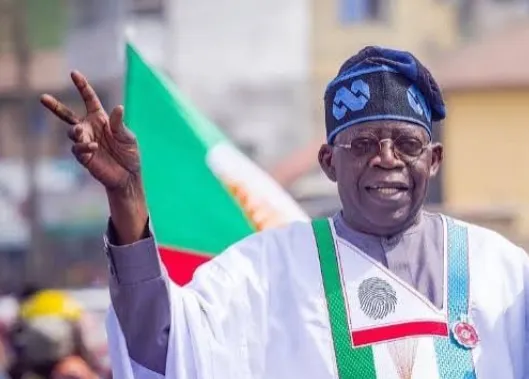
The Chairman of the Nigerian Ports Authority (NPA), Senator Dayo Adeyeye, has expressed confidence that President Bola Ahmed Tinubu will win the 2027 presidential election in all 36 states of the federation.
Adeyeye, who is also the National Chairman of the South-West Agenda for Asiwaju (SWAGA), attributed his prediction to what he described as the achievements of the Tinubu administration and the growing political support for the President across the country.
He made the remarks while speaking with journalists in Ado Ekiti on Wednesday, insisting that opposition parties, particularly the African Democratic Congress (ADC), lacked the political structure and grassroots support required to challenge the ruling All Progressives Congress (APC).
The former National Assembly member said Tinubu’s performance during his first term and the prospects of his proposed second term had placed him ahead of other potential presidential contenders.
According to Adeyeye, the Federal Government’s economic reforms have significantly increased financial allocations to state governments, enabling them to meet obligations such as workers’ salaries, pensions and gratuities.
He maintained that the improved revenue available to state governments had strengthened their capacity to execute projects and deliver development programmes.
“I said over three months ago that President Tinubu was likely to win all 36 states, and I am becoming increasingly convinced that it will happen.
“I am absolutely confident and ready to campaign anywhere for Tinubu. I believe he deserves massive support in the 2027 election, and now, I predict that he will win in all the states of the federation,” he said.
Adeyeye explained that SWAGA was established to strengthen Tinubu’s political support base in the South-West, stressing that a presidential candidate needed a solid political foundation in his home region to secure wider national acceptance.
He noted that Tinubu had established a formidable political network across the South-West, adding that the President’s support base had continued to expand beyond the region.
Although he acknowledged the economic difficulties confronting Nigerians, Adeyeye defended the administration’s major economic policies, particularly the removal of the petrol subsidy and the unification of the foreign exchange market.
He argued that the reforms had prevented Nigeria from sliding into a deeper economic crisis, maintaining that the country was facing an unsustainable fiscal situation before Tinubu assumed office in May 2023.
Adeyeye recalled the period of prolonged fuel scarcity, long queues at filling stations and the activities of black-market operators, saying the removal of the subsidy had helped improve the availability of petrol despite the increase in its pump price.
He also maintained that the foreign exchange reforms had improved transparency, reduced opportunities for currency arbitrage and strengthened government revenue.
The NPA chairman further cited the Federal Government’s student loan scheme and increased funding for universities as evidence of efforts to reduce the financial burden on households and improve access to education.
He commended Tinubu for addressing funding challenges in the university system, arguing that improved remuneration and financial support had contributed to industrial harmony and reduced the recurrence of strikes by the Academic Staff Union of Universities.
On the opposition, Adeyeye questioned the political strength of the ADC and its ability to mount a serious challenge against the APC in 2027.
He specifically dismissed the party’s chances under former Vice-President Atiku Abubakar, arguing that it lacked the governors, legislative representation and grassroots structures needed to compete effectively against an incumbent president.
“ADC is a party without a governor in any of the 36 states. How many members does it have in the National Assembly? How many state assemblies does it control? You cannot compare a party without a demonstrable political structure with the APC,” he said.
Adeyeye also questioned Atiku’s political influence in his home state of Adamawa, noting that the state governor was not supporting his presidential ambition.
He argued that the former Vice-President would struggle to defeat an incumbent president without first establishing a strong political foundation in his home state.
Tinubu won the February 2023 presidential election with 8,794,726 votes, defeating Atiku, who secured 6,984,520 votes, and the Labour Party’s Peter Obi, who polled 6,101,533 votes, according to results declared by the Independent National Electoral Commission (INEC).
Since assuming office in May 2023, Tinubu has introduced major economic reforms, including the removal of the petrol subsidy and changes to the foreign exchange market.
While the World Bank has acknowledged that the reforms addressed longstanding fiscal and foreign exchange market distortions, it has also highlighted the difficult economic adjustments they have imposed on Nigerian households and businesses.
Meanwhile, the ADC has been facing a leadership crisis ahead of the 2027 general elections.
On November 5, 2026, the Federal High Court in Abuja nullified the emergence of the David Mark-led national leadership and invalidated decisions taken by the group, including the process that produced Atiku as the party’s presidential candidate.
The party subsequently appealed the judgment and sought a stay of execution, urging INEC to suspend further action pending the determination of the appeal.
Join us on our WhatsApp Platform @KOIKIMEDIA NEWS YOUR PAGE
koikimedia Bringing the World 🌎 Closer to Your Doorstep

[mc4wp_form id=2402]