Physical Address
304 North Cardinal St.
Dorchester Center, MA 02124
Physical Address
304 North Cardinal St.
Dorchester Center, MA 02124

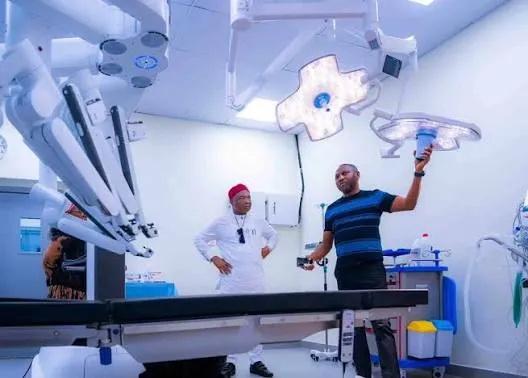
Surgeons at Redeemer’s Health Village, Ogun State, have said robotic-assisted surgery can significantly reduce patients’ pain, minimise tissue damage and shorten hospital stays due to the smaller incisions used during procedures.
The experts explained that robotic technology provides surgeons with enhanced visualisation, greater precision and improved control during operations, which can help reduce blood loss and postoperative discomfort while supporting faster recovery.
They spoke on Wednesday at Redeemer’s Health Village after the hospital successfully performed its first robotic-assisted surgery — a prostate cancer operation on a middle-aged man.
The procedure was carried out by urology specialists, the hospital’s in-house medical team and robotic surgeons from RoboMed Global Inc., a United States-based medical technology company.
Speaking on the development, the Chief Executive Officer of Redeemer’s Health Village, Dr Ademola Dada, described robotic-assisted surgery as a minimally invasive procedure capable of providing greater surgical precision and faster recovery.
Dada said patients undergoing such procedures could potentially be discharged on the same day or the following day, depending on their condition.
“The patient goes home almost the same day or the next day, so there’s less trauma, and then, of course, success is better,” he said.
The RHV chief executive said the hospital was committed to making advanced healthcare services more accessible and affordable to Nigerians.
He said the facility’s long-term ambition was to become a leading destination for healthcare delivery, not only in Nigeria but across Africa.
“For robotic surgery, the projection is that we wanted to make this affordable so that every single patient with conditions like prostate cancer and all of those things that robotic surgeries can do would have robotic surgery, because it gives better results and more precision,” Dada said.
He added that the hospital would expand the use of robotic-assisted surgery beyond prostate cancer to other medical conditions.
According to him, the facility is exploring procedures involving cervical cancer, uterine cancer and colon cancer, among other conditions.
Dada also disclosed that one of the planned procedures would involve a 28-year-old medical doctor who was born with a congenital kidney deformity that had begun affecting the organ.
He said the patient’s kidney had not been completely damaged, adding that the planned robotic procedure could help address the problem and give her an opportunity to live a normal life.
Also speaking, Professor of Urology and robotic surgeon, Obi Davies-Ekwenna, said robotic-assisted surgery could improve surgical outcomes by allowing doctors to operate through smaller incisions while using a highly magnified camera.
He explained that the technology also provides surgeons with a greater range of movement and allows them to carry out highly precise procedures that may be difficult to perform with the human hand alone.
According to Davies-Ekwenna, robotic systems can reduce the effect of natural hand tremors and provide surgeons with better control when manipulating tissues.
He stressed, however, that the robotic system does not independently perform the operation, noting that the surgeon remains responsible for controlling the machine and making critical decisions throughout the procedure.
“The machine does not operate on its own, at least not yet. We still control the machine. So, the surgeon is still responsible for the surgery, still has to know where things are and how to move things around,” he said.
Davies-Ekwenna, who is also the Chief Executive Officer of RoboMed Global, said patients could benefit from reduced postoperative pain because robotic surgery involves smaller surgical wounds.
He added that the smaller incisions could also lower the risk of wound infections and allow patients to return home sooner.
“Because there’s a smaller incision, there’s also less pain. Less wound infection. Because people get wound infections from big cuts. So, there’s less wound infection.
And the patient can go home literally the next day,” he said.
The successful procedure marks the beginning of Redeemer’s Health Village’s planned expansion into robotic-assisted surgery, with the facility targeting a wider range of complex procedures as it seeks to make advanced surgical care more accessible to patients in Nigeria and beyond.

[mc4wp_form id=2402]