

Gaza residents reported intense attacks on densely populated neighbourhoods including Shujaiya, Tuffah, and Zeitoun. One of the strikes reportedly hit a school sheltering displaced people in Zeitoun
By Afolabi Ayodele
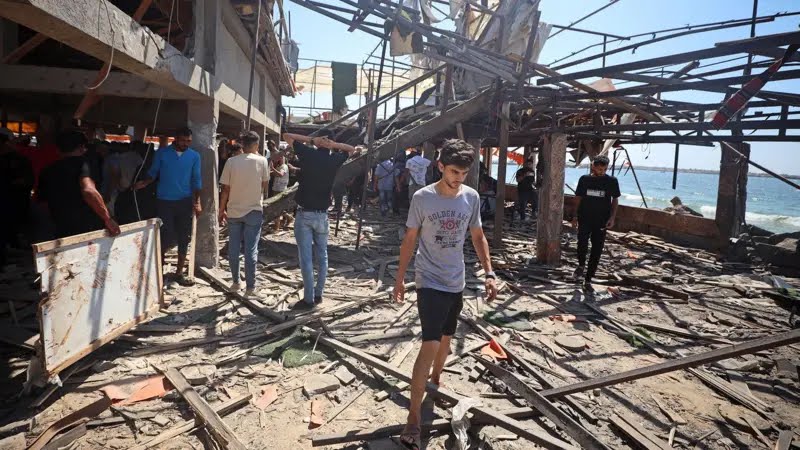
At least 20 Palestinians were killed on Monday following an Israeli airstrike on the popular Al-Baqa Cafeteria, a beachside café in western Gaza frequented by journalists, activists and residents, according to eyewitnesses and rescue officials.
Medics said dozens of others were injured in the attack, which left a deep crater at the site.
Emergency crews were still combing through the debris late into the evening.
A spokesperson for Gaza’s Hamas-run Civil Defence told the BBC that 20 bodies were recovered from the outdoor café, which was set up with tents along the coast and known for providing internet access and workspace.
“I was on my way to the café to use the internet just a few metres away when a massive explosion hit,” said Aziz Al-Afifi, a local cameraman. “I ran to the scene. My colleagues were there, people I meet every day. The scene was horrific – bodies, blood, screaming everywhere.”
Footage shared by activists on social media showed the moment the missile, reportedly fired from an Israeli warplane, struck the area, followed by scenes of carnage.
The Israeli military has not issued any comment on the incident.
The strike on the café came amid a fresh wave of Israeli air raids overnight across the Gaza Strip, displacing hundreds of families. Local reports said five people were killed and dozens injured in other strikes, with many of the wounded taken to Al-Ahli Hospital in Gaza City.
The latest bombardment followed one of the largest evacuation orders since the war resumed in March, prompting speculation about a broader Israeli ground offensive.
Gaza residents reported intense attacks on densely populated neighbourhoods including Shujaiya, Tuffah, and Zeitoun. One of the strikes reportedly hit a school sheltering displaced people in Zeitoun.
“Explosions never stopped… it felt like earthquakes,” said 60-year-old Salah from Gaza City. “In the news we hear a ceasefire is near, on the ground we see death and we hear explosions.”
Another fatal strike hit Al Shati camp, west of Gaza City, where five bodies were recovered.
Most of those displaced ignored IDF instructions to move south, choosing instead to relocate west within Gaza City.
“We had no choice but to leave everything behind,” said Abeer Talba, a mother of seven from Zeitoun. “We got phone call recordings in Arabic telling us to evacuate immediately. This is the seventh time we’ve fled. We’re in the streets again, no food, no water. My children are starving. Death feels kinder than this.”
The humanitarian crisis continues to deepen, with observers warning that evacuation orders and relentless bombardments signal an intent to escalate ground operations.
Meanwhile, pressure is mounting on Israeli Prime Minister Benjamin Netanyahu to pursue a ceasefire deal. US President Donald Trump said over the weekend that Netanyahu was negotiating with Hamas “right now,” though a previous three-phase truce agreement collapsed in March after just one stage.
Since then, Israel has enforced a total blockade on humanitarian aid, later partially eased under US pressure with the creation of the Gaza Humanitarian Foundation (GHF). However, reports of killings near aid distribution points persist. Eyewitnesses blame Israeli forces, though the military claims to have only fired warning shots.
According to Gaza’s Hamas-run health ministry, more than 56,000 people have been killed since the war began, following Hamas’ October 7 attack in which around 1,200 Israelis were killed and 251 taken hostage.
With the conflict dragging on, some Israeli military officials reportedly believe the objectives in Gaza are nearly achieved, while others fear prolonged guerilla warfare could cost more lives—including those of hostages.
Join us on our WhatsApp Platform @KOIKIMEDIA NEWS YOUR PAGE
KoikiMedia Bringing the World 🌎 Closer to Your Doorstep