Physical Address
304 North Cardinal St.
Dorchester Center, MA 02124
Physical Address
304 North Cardinal St.
Dorchester Center, MA 02124

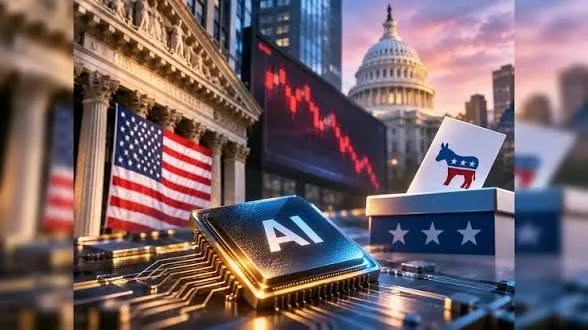
United States financial markets recorded significant losses on Thursday as technology stocks, particularly companies involved in artificial intelligence (AI), semiconductor production and data centre operations, suffered a major selloff following the Democratic Party’s sweeping victory in the 2026 midterm elections.
The technology-heavy Nasdaq Composite Index dropped 4.8 per cent in midday trading, while the S&P 500 declined by 3.6 per cent. The Dow Jones Industrial Average also fell by 2.8 per cent.
The downturn was largely driven by concerns among investors that the Democrats’ electoral success could result in increased political and regulatory resistance to the expansion of artificial intelligence infrastructure across the United States.
US markets had rallied on Wednesday following the election results, as investors initially welcomed the political outcome and indications that the new balance of power in Congress could limit sudden policy changes.
However, trading sentiment changed on Thursday as investors began assessing the possible implications of the Democratic victory for major technology companies and their investment plans.
Artificial intelligence-related stocks, which have contributed significantly to recent market growth, led the decline, with semiconductor manufacturers, data centre operators and other technology companies recording substantial losses.
The Nasdaq’s 4.8 per cent decline represented its sharpest fall since April 2, 2025, when President Donald Trump announced his sweeping tariff policies, a day he described as ‘Liberation Day’.
The market decline followed a series of local ballot decisions across the United States, where voters supported restrictions on several proposed data centre and AI-related developments.
According to Data Centers on the Ballot, 39 of the 45 ballot initiatives concerning data centre restrictions were successful, while only one initiative in North Dakota rejected the proposed restrictions.
Analysts at UBS estimated that possible construction suspensions could put approximately 30 per cent of planned additions to US data centre capacity in 2028 at risk.
Michael Monaghan, portfolio manager of Founders 100 ETF, said investors were reassessing the implications of the election results, particularly the possibility of increased opposition to AI infrastructure projects at state and local government levels.
He explained that the concerns were reflected in the widespread selloff involving semiconductor manufacturers and major technology companies.
Among the biggest losers were data centre operators and emerging cloud computing companies.
CoreWeave shares dropped by more than 12 per cent, while Nebius Group declined by nearly 17 per cent.
Leading semiconductor manufacturers also suffered significant losses, with Nvidia falling by 8.2 per cent, Micron declining by almost 14 per cent and Intel losing 6.8 per cent.
Dell Technologies, a major manufacturer of AI servers, also recorded a decline of nearly 13 per cent.
Other major technology companies were not spared, as Amazon shares dropped by two per cent, while Meta, the parent company of Facebook and Instagram, declined by 3.8 per cent.
SpaceX also recorded a 9.5 per cent fall, while Tesla shares dropped by more than 11 per cent amid concerns about the political and regulatory implications of the election outcome.
The losses came after billionaire businessman Elon Musk reportedly spent hundreds of millions of dollars supporting Republican candidates during the midterm election campaigns.
In Texas, where SpaceX and Tesla are headquartered, Musk backed several Republican candidates who subsequently lost their respective elections.
His political spending reportedly included $230 million against Democratic Senate candidate James Talarico, $5 million supporting the opponent of gubernatorial candidate Gina Hinojosa and another $500,000 in the lieutenant governor’s race, which Democrat Vikki Goodwin won.
Dan Ives, managing partner of Yorkville Ives, suggested that the new political environment could complicate the possibility of a proposed merger involving SpaceX and Tesla, particularly because of potential regulatory challenges in Washington and Texas.
Meanwhile, gold prices moved in the opposite direction as investors sought safer investment options amid uncertainty in the financial markets.
Spot gold rose by slightly more than one per cent to approximately $4,115 per ounce, reaching its highest level in two weeks.
The technology selloff also affected European financial markets, pulling down the region’s benchmark stock index as investors assessed the potential impact of the American election results on the global technology industry.
Ipek Ozkardeskaya, senior analyst at Swissquote Bank, described the development as a shift in investment interests from technology to non-technology sectors and from US markets to other international markets.
The latest market movement highlights growing investor concerns about the political, regulatory and economic challenges facing the artificial intelligence industry following the Democrats’ strong performance in the US midterm elections.
Join us on our WhatsApp Platform @KOIKIMEDIA NEWS YOUR PAGE
Koikimedia Bringing the World 🌎 Closer to Your Doorstep

[mc4wp_form id=2402]